By Keshavan Thiagaraja
A systems critique of the one design decision that separates enterprise-grade agentic AI from an expensive science experiment.
The Uncomfortable Truth
Most enterprises are not building multi-agent systems. They are building multi-agent chaos.
They deploy a claims agent here, a scheduling agent there, a document agent somewhere else. Each one is clever. None of them is accountable. When the auditor asks who approved a decision, the answer is a shrug and a log file nobody can read.
Gartner has predicted that over 40 percent of agentic AI projects will be cancelled by the end of 2027, citing escalating costs, unclear business value and inadequate risk controls. Read that last phrase again. Inadequate risk controls. That is not a model problem. That is an architecture problem.
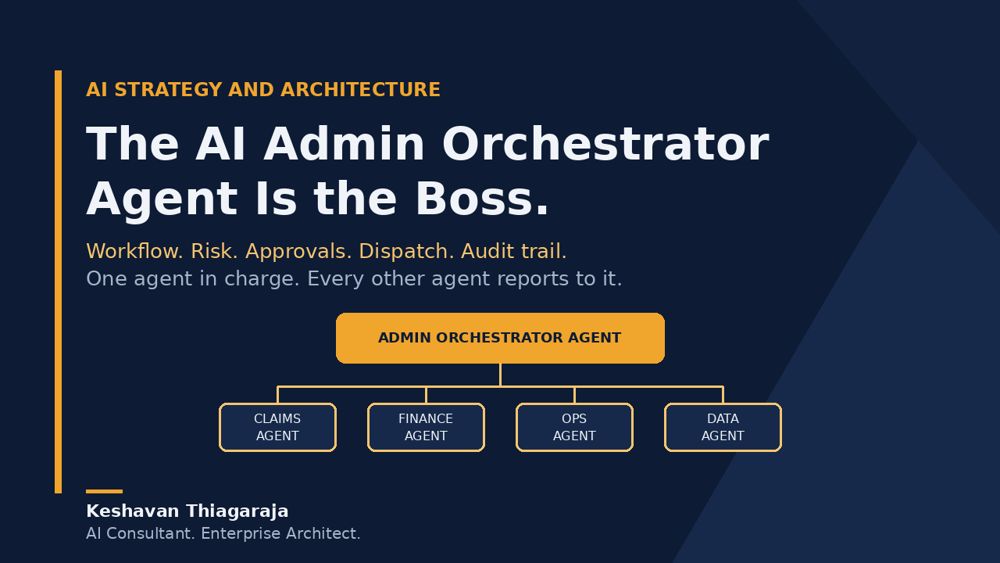
The fix is a single, deliberate design decision: one agent is the boss. I call it the AI Admin Orchestrator Agent. Every other agent reports to it. It owns five things and refuses to delegate them: the workflow, the risk decisions, the approvals, the dispatch path and the audit trail.
This article explains why that hierarchy is not optional, how it works in practice, and what it means for the executives who will sign off on it.
Why Peer-to-Peer Agent Swarms Fail in the Enterprise
There are two competing philosophies in multi-agent design, and the choice between them is a strategic decision, not a technical preference.
A decentralised swarm lets agents hand work to each other directly. It feels modern and flexible, but authority is diffuse, failure is emergent, and no single component can answer for the system. An orchestrated hierarchy routes every meaningful decision through one supervisory agent. It feels bureaucratic, but authority is explicit, failure is contained, and one component can always answer for the system.
A swarm optimises for agent autonomy. An orchestrator optimises for organisational accountability. A swarm asks what each agent can do. An orchestrator asks what the enterprise is allowed to do. In a regulated business, only one of these philosophies survives contact with a compliance department.
The industry has quietly reached the same conclusion. Amazon Bedrock built its multi-agent collaboration feature around a supervisor agent that plans, routes and consolidates the work of subordinate agents. LangGraph documents the supervisor pattern as its canonical multi-agent architecture. Microsoft and Salesforce have both converged on orchestration layers that sit above their specialist agents. The vendors did not converge on hierarchy by accident. They converged because enterprise buyers kept asking the same question: who is in charge?
The Five Things the Orchestrator Must Own
Think of the AI Admin Orchestrator Agent as the chief operating officer of your digital workforce. Five responsibilities sit on its desk and nowhere else.
First, the workflow. The orchestrator decomposes every incoming request into steps, decides the sequence, and assigns each step to a specialist agent. Specialist agents never self-assign work.
Second, the risk decisions. Every action is scored before it is dispatched. Reading a knowledge base is low risk. Emailing a customer is medium risk. Issuing a refund, changing a record of authority or touching production infrastructure is high risk. The scoring rubric lives in the orchestrator, in one place, version controlled and reviewable.
Third, the approvals. Low risk actions proceed automatically. Medium risk actions proceed with enhanced logging. High risk actions stop and wait for a named human to approve. The specialist agent cannot bypass this gate because the specialist agent never holds the credentials to act alone.
Fourth, the dispatch path. The orchestrator decides not only what happens but through which channel and with which permissions. A payment instruction goes through the payment gateway with a scoped token, not through a general-purpose tool with broad access.
Fifth, the audit trail. Every decomposition, every risk score, every approval, every dispatch and every result is written to an immutable log in one format. When a regulator, an auditor or an angry customer asks what happened, the answer is a query, not an archaeology project.
A Concrete Example: The Insurance Claim
A customer lodges a motor claim at 11 pm. The intake agent extracts the details from the form and photographs. The orchestrator receives the structured claim and begins its work.
It routes the damage photographs to an assessment agent, which estimates repair cost at 4,200 dollars. It routes the policy number to a coverage agent, which confirms the policy is active and the excess is 800 dollars. It routes the claim history to a fraud agent, which returns a low anomaly score.
Now the orchestrator makes the decision the specialists cannot make. Payout value under 5,000 dollars, fraud score low, coverage confirmed. Its risk policy says this combination is auto-approvable. It dispatches payment through the payments channel, notifies the customer, and writes eleven entries to the audit trail, including the exact policy version used to approve the payout.
Same claim, but the fraud score comes back elevated. Nothing changes in the specialist agents. The orchestrator withholds dispatch, packages the evidence, and routes the case to a human claims officer with a deadline and a recommendation. The customer is told a decision is coming within 24 hours. The audit trail records that a human, by name, made the final call.
One architecture. Two outcomes. Zero improvisation.
The Regulatory Clock Is Ticking
This is no longer just good engineering hygiene. The EU AI Act's obligations arrive in stages, with the high risk system requirements landing from August 2026, and they demand exactly what the orchestrator provides: logging, traceability, human oversight and documented risk management. Similar expectations are emerging from regulators in financial services, healthcare and critical infrastructure worldwide. An enterprise that cannot reconstruct an AI decision will soon be an enterprise that cannot defend one.
What CEOs Should Do
Ask one question in your next AI steering meeting: which single component in our agent architecture owns approvals and the audit trail? If the answer contains the word various, you have a governance gap dressed up as innovation. Fund the orchestration layer as a first-class programme, not as plumbing. Tie your AI investment gates to auditability, so no agent reaches production without reporting to the orchestrator. And insist that the risk rubric is a board-visible document, because it encodes your company's appetite in software.
The CTO Checklist
Adopt a supervisor pattern as your default multi-agent topology and make exceptions justify themselves. Centralise credentials in the orchestrator and issue scoped, short-lived tokens to specialist agents. Define risk tiers with explicit thresholds for autonomous action, enhanced logging and mandatory human approval. Standardise one audit event schema across every agent, and test it by running a mock investigation before your regulator runs a real one. Finally, measure the orchestrator itself: routing accuracy, approval latency and audit completeness belong on your engineering dashboard next to uptime.
The Bottom Line
Autonomy is a feature. Accountability is the product. The AI Admin Orchestrator Agent is how you buy both, because it lets your specialist agents be brilliant while one supervisory brain remains answerable for everything they do.
The companies that get this right will scale their digital workforce with confidence. The companies that get it wrong will join the 40 percent.
Here is my question for you: in your organisation today, if an AI agent made a bad call at 11 pm, could you name the component that approved it and produce the log by morning?
Think mathematically. Engineer intelligently. Lead strategically. Build responsibly. Scale globally. Create real business value through artificial intelligence.
#AgenticAI #MultiAgentSystems #AIOrchestration #AIGovernance #EnterpriseArchitecture #AIStrategy #ResponsibleAI #EUAIACT #CIO #CTO #DigitalTransformation #ArtificialIntelligence
Originally published on LinkedIn by Keshavan Thiagaraja. Read the original on LinkedIn.