
By Keshavan Thiagaraja
It is 5:00 PM on a Friday evening in Sydney's CBD.
Offices empty in minutes. Restaurants fill up. 40,000 people open their Uber app at almost the same moment. Rain has just started falling.
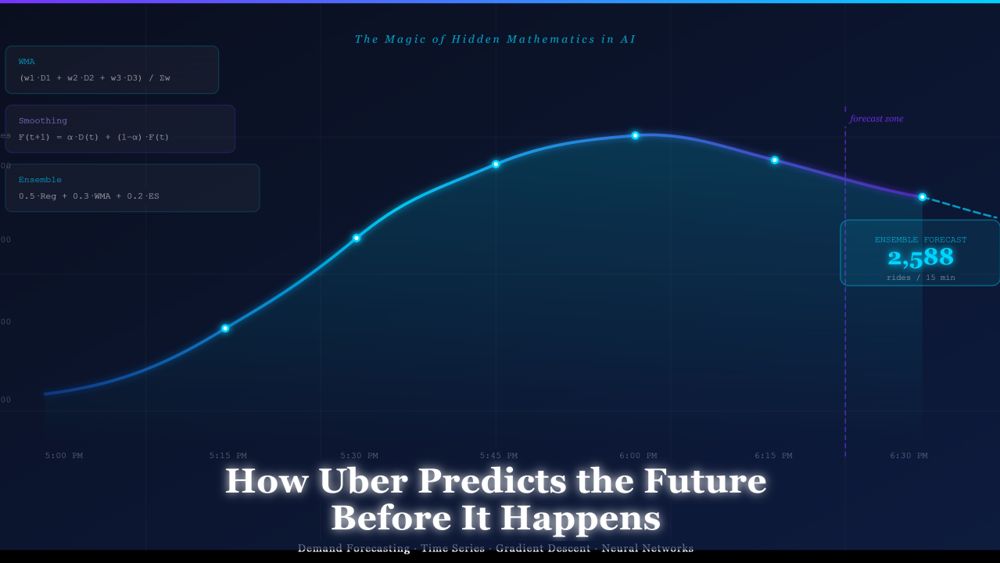
The question Uber must answer right now is brutally simple. How many ride requests will arrive in the next 15 minutes?
Get it wrong and the consequences are immediate. Long waits. Cancellations. Customers switching to competitors. At Uber's scale, a small error in prediction is not a rounding problem. It is a revenue problem measured in millions.
Most people think Uber works reactively. A rider opens the app and the system scrambles to find a driver nearby. That is not how it works.
Uber's AI systems run demand forecasts continuously, 24 hours a day. By the time you open the app on a Friday evening, Uber already knew you were coming. The driver who picks you up may have been repositioned 20 minutes earlier based on a forecast that predicted demand in that exact location at that exact time.
That capability is not built on intuition. It is built on mathematics.
A 1 percent improvement in forecasting accuracy at Uber's volume translates to hundreds of millions of dollars in additional annual revenue. Not from one dramatic change, but from thousands of small inefficiencies removed simultaneously, compounding every hour across every city.
This is Part 1 of a 5-part series on how Uber predicts the future before it happens.
Part 2 covers the three-model ensemble architecture. Part 3 walks through every formula with real numbers from a Friday evening in Sydney. Part 4 builds the full implementation from scratch in Python. Part 5 shows the production PyTorch blueprint running at scale.
Every calculation verified. Every line of code runs.
Follow along. The mathematics is more accessible than most people expect.
#MachineLearning #ArtificialIntelligence #AI #DataScience #Mathematics #Uber #TimeSeriesForecasting #DemandForecasting #AIEngineering #TechLeadership #TheMagicOfHiddenMathematicsInAI #PredictiveAnalytics #DeepLearning #MLOps #Python
Originally published on LinkedIn by Keshavan Thiagaraja. Read the original on LinkedIn.